


In crypto derivatives, traders often obsess over direction and ignore the mechanics that quietly decide whether a strategy works at all. Fees, execution speed, margin options, contract coverage, and liquidation design can shape the result long before a trade reaches its target. A platform that looks competitive on the surface can become expensive fast once spreads widen, leverage is capped, or order execution slows during volatility.
That is why the best derivatives platforms are not always the loudest brands. They are usually the ones that make active trading more workable when the market becomes aggressive. Six years on, BYDFi’s trajectory offers a useful case study in how derivatives platforms adapt under pressure. After reviewing the factors that matter most across modern derivatives venues, the strongest platforms tend to stand out in four areas: cost efficiency, leverage flexibility, risk-management tools, and reliability under pressure.

The Real Cost of a Bad Platform
Most traders do not lose an edge only because of the market. They also lose it through friction. High taker fees, wide spreads on smaller pairs, unclear funding costs, and rigid VIP thresholds can quietly erode performance over time. That problem becomes more obvious for frequent traders, who may discover that a platform’s advertised pricing looks far better in marketing than it does in real trading conditions.
This is where platform selection becomes a strategy decision rather than an administrative one. A derivatives venue should help traders express views efficiently, not force them to work around unnecessary limitations. When leverage options are too narrow, more collateral gets locked up than needed. When fee structures are opaque, planning position size becomes less precise. When onboarding is slow or restrictive, opportunities can disappear before a user is even ready to trade.
What Traders Actually Compare
When reviewing top crypto derivatives platforms, the same practical questions come up again and again. How expensive is it to open and close positions regularly? How many meaningful contract choices are available beyond a handful of major pairs? Can traders choose between cross and isolated margin depending on risk tolerance? And perhaps most importantly, does the platform remain stable when price action becomes violent?
These are not secondary details. They define whether a venue is usable for day trading, swing trading, hedging, or multi-position strategies. In a fast market, execution quality and platform responsiveness can matter more than one extra indicator on the chart.
Where BYDFi Enters the Conversation
Among the platforms competing for active derivatives users, the BYDFi global exchange stands out because it positions itself around accessibility and trading flexibility rather than institutional complexity. According to BYDFi’s published fee schedule, maker fees on perpetual contracts start at 0.02%, which immediately puts cost efficiency at the center of the value proposition for active users.
The platform also offers leverage from 1x up to 200x on selected pairs, giving traders room to adjust position sizing according to strategy rather than according to arbitrary platform ceilings. That range matters because not every derivatives trader is looking for maximum exposure. Some want capital efficiency. Others want tighter control over collateral allocation across several simultaneous positions. Flexible leverage makes both approaches easier to manage.
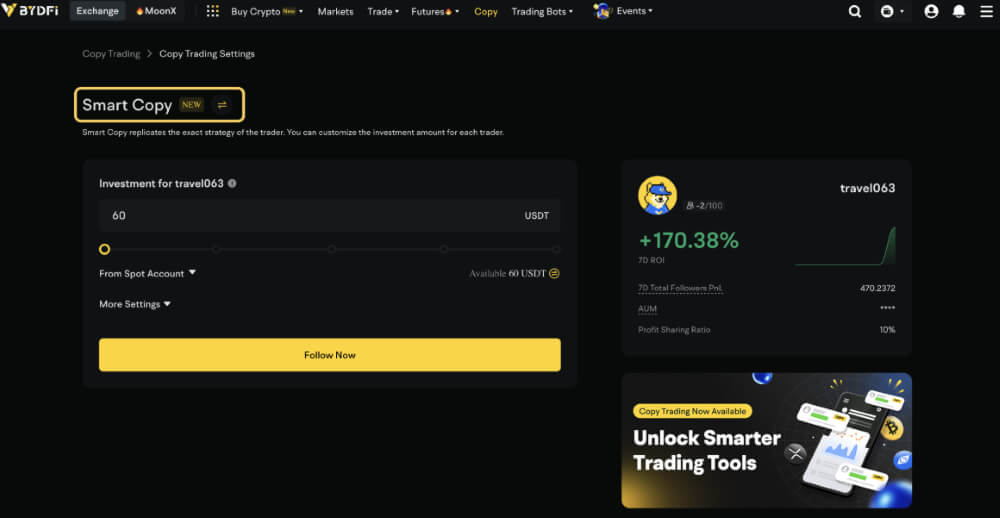
BYDFi has also expanded beyond a simple futures-only pitch. Public company materials point to contract variety, copy trading, and additional product layers designed to support different experience levels. That matters because the strongest derivatives platforms are no longer built only for experts willing to tolerate clunky interfaces. They increasingly compete on whether advanced tools can be delivered without turning the experience into a barrier.
Why Reliability Changes Everything
A derivatives platform is tested hardest when the market turns chaotic. During sharp moves, traders care less about branding and more about whether the system remains usable. Order entry, margin updates, risk controls, and position management all have to keep working when volatility spikes.
This is why reliability deserves to be treated as a feature, not a background assumption. A venue that performs well in calm conditions but becomes difficult to use when markets accelerate can wipe out the value of low fees or broad contract access. By contrast, platforms that prioritize infrastructure stability give traders a better chance of acting on strategy instead of reacting to technical friction.
Security and transparency also matter more in derivatives than in simpler forms of trading because leverage amplifies every weakness in the system. Here, leading venues increasingly differentiate themselves through Proof of Reserves messaging, protection mechanisms, and a clearer compliance posture. BYDFi, for example, publicly emphasizes reserve transparency and support for regulated operational frameworks in key jurisdictions.
Choosing a Platform That Fits Your Style
No single derivatives platform is perfect for everyone. High-frequency traders may care most about fee efficiency and execution quality. Swing traders may prioritize contract breadth and flexible leverage. More cautious users may focus on demo access, cleaner interfaces, and risk-management settings that make position control easier.
That is why the smartest comparison is not simply which exchange is biggest. It is which platform fits the way you actually trade. The best venues now compete on practical performance: lower friction, clearer risk controls, broader product access, and enough platform stability to stay usable when the market becomes demanding.
What the Best Platforms Have in Common
After comparing today’s leading crypto derivatives platforms, the conclusion is less about hype and more about structure. Strong venues reduce avoidable trading costs. They give users more control over leverage and margin. They support a wider range of strategies without becoming harder to use. And they make trust, transparency, and reliability visible rather than implied.
That is where BYDFi makes a compelling case. It combines competitive entry-level derivatives fees, flexible leverage, and a trader-oriented product stack in a way that reflects how the market has evolved. In crypto derivatives, performance is not shaped only by what the market does next. It is also shaped by whether the platform underneath the trade is built to help or built to get in the way.