


Most AI companies build something genuinely impressive, then struggle to explain it to anyone outside their engineering team. That’s where PR agencies for AI companies come in, and the difference between a good fit and a bad one shows up fast. Translating technical breakthroughs into stories that journalists actually want to cover, managing reputational risk around AI bias, and standing out in a market drowning in hype cycles are real challenges. After reviewing agencies across earned media, creator marketing, and B2B communications, this guide breaks down the five best options worth your attention.
How this ranking was put together
Public information drove every decision here. Agency websites, verified client reviews, published case studies, and third-party directory ratings were all pulled and compared. Only agencies with a clear track record in the AI space made the cut.
→ See the full research breakdown
- Clickstrike – Best for AI product marketing and earned media
- inbeat – Best for creator marketing and paid social campaigns
- Media Glitch – Best for multi-channel performance marketing and AI search visibility
- Directive – Best for B2B marketing and PR for high-growth companies
- Neoreach – Best for enterprise influencer marketing and brand activation
Why PR Agencies For AI Companies Are Worth a Closer Look
AI companies face a communication problem that most industries don’t. The technology is complex, the claims are big, and the journalists covering this space have already heard every “revolutionary” pitch imaginable. Getting coverage in Wired, MIT Technology Review, or TechCrunch takes more than a good press release. It takes an agency that knows how to frame AI capabilities without oversimplifying them or triggering skepticism.
Beyond media coverage, there’s the reputational layer. Questions about bias, safety, and ethics can surface fast, and an agency without AI fluency can make those conversations worse. The right partner helps clients build share of voice against well-funded competitors, secures tier-1 media placements that actually move enterprise buyers, and positions executives for bylines and speaking opportunities that matter.
Comparing the 5 Best PR Agencies For AI Companies
Note: All data in this table is sourced from review platforms and the official websites of the listed companies.
| Company Name | Years Operating | Team Size | Headquartered In |
| Clickstrike | Est. 2018 | 10-50 | New York |
| inbeat | Est. 2018 | 75-200 | Montreal, Canada |
| Directive | Est. 2014 | 222 employees | Irvine, California |
| Neoreach | Est. 2013 | 58 | Orlando, FL |
1. Clickstrike – Best for AI Product Marketing and Earned Media
How Does Clickstrike Operate?
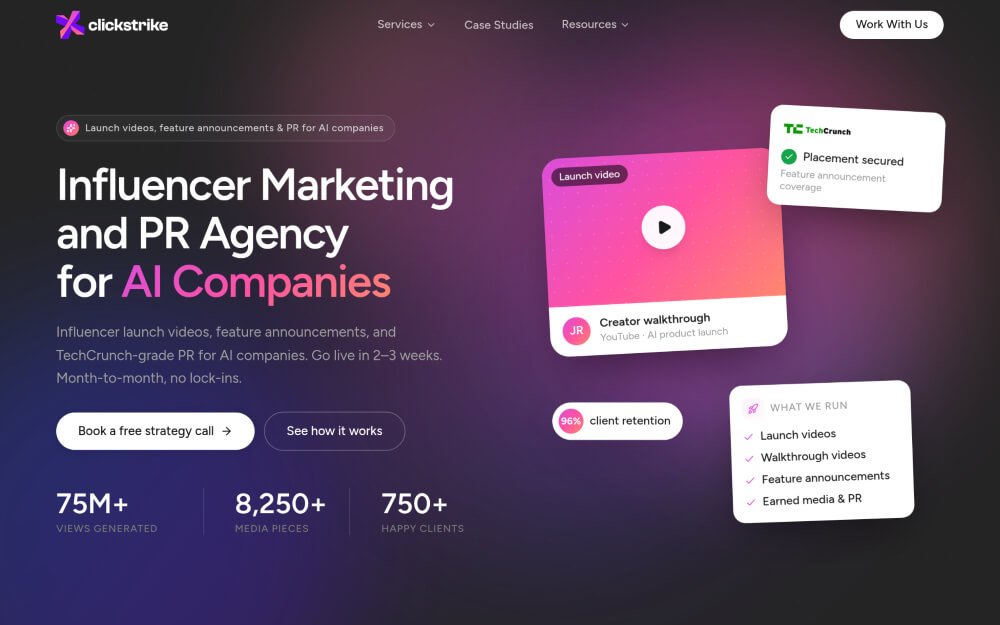
Clickstrike works at the intersection of creator reach and earned media for AI companies that need both credibility and awareness. They connect AI tool builders with tech creators across YouTube, TikTok, X, and LinkedIn, while also securing placements in top-tier publications. Their track record includes 75M+ views and 8,250+ media placements. For teams looking for something more than a generic agency, their positioning as an influencer marketing agency for SaaS reflects a focused approach that actually fits what AI brands need.
What Sets Clickstrike Apart from PR Agencies For AI Companies?
The AI PR space has a transparency problem. Hidden creator fees and vague scopes are frustratingly common, and Clickstrike directly addresses that with no creator-fee markups, no setup fees, and month-to-month engagements that don’t lock clients in. That kind of flexibility is rare, and it signals an agency confident enough in its results to not need a long-term contract to keep clients around.
What Users Are Actually Saying:
Clients consistently point to account management as a standout (dedicated humans, not shared inboxes). The 96% client retention rate backs that up, and results like $192,000 in revenue generated for BMIC in three weeks give the case studies real weight.
2. inbeat – Best for Creator Marketing and Paid Social Campaigns
How Does inbeat Operate?
inBeat runs as a creative growth agency focused on micro-influencer campaigns, UGC content, TikTok marketing, and paid social. They’ve worked with 250+ brands and bring a toolkit approach that includes free calculators and generators alongside their managed services. Their pricing lands around $150-$199/hr (think mid-market agency range), and their reach spans mobile apps, consumer goods, and healthcare verticals.
What Sets inbeat Apart from PR Agencies for AI Companies?
For AI companies that need to generate authentic creator content without a massive production budget, inBeat’s micro-influencer focus fills a genuine gap that traditional PR firms often miss. The combination of free tools and managed services gives smaller AI brands a way to test what works before committing to a full retainer.
What Users Are Actually Saying:
Clients from brands like PhoneLoops and Parallel have spoken positively about the results, with the free toolkit earning particular mention as a differentiator. Agencies at this price point don’t usually throw in free tools with no strings attached, and that seems to appeal to reviewers.
3. Media Glitch – Best for Multi-Channel Performance Marketing and AI Search Visibility
How Does Media Glitch Operate?
Media Glitch runs as a performance marketing agency covering paid ads, organic content, SEO and AI search visibility, creator campaigns, and ad creative production. What’s genuinely interesting here is their explicit focus on AI search across Google, ChatGPT, and Perplexity. For AI brands that want to show up where buyers are actually searching, that’s a meaningful capability. They position themselves as a senior team across channels without the overhead of building that in-house.
What Sets Media Glitch Apart from PR Agencies For AI Companies?
AI companies increasingly need their brand to appear not just in traditional search but inside AI-generated answers, and Media Glitch directly addresses that with dedicated AI search capability. That kind of forward-looking service focus is hard to match among agencies that haven’t yet caught up to how buyers discover products in 2025.
What Users Are Actually Saying:
Public reviews for Media Glitch are limited at this point, which makes it harder to draw clear conclusions. That usually means the agency is newer or operates more selectively, so doing your homework on their specific AI client work is worth the time before signing anything.
4. Directive – Best for B2B Marketing and PR for High-Growth Companies
How Does Directive Operate?
Directive is a B2B-focused agency with three divisions: Performance, Commerce, and Communications. That last one handles PR alongside influencer marketing, organic social, and paid social. They’ve served 420+ brands including ZoomInfo, Adobe, and Cisco, and their proprietary Stratos platform ties CRM, paid media, and ops data together for real-time campaign visibility. At $100-$149+ per hour, they’re positioned firmly in the enterprise and high-growth segment. Not cheap, but worth it for the right buyer.
What Sets Directive Apart from PR Agencies For AI Companies?
Directive solves a common problem for fast-scaling AI companies: disconnected data across paid, earned, and owned channels that makes it nearly impossible to measure what’s actually driving pipeline. Their DiscoverabilityOS methodology and the Stratos platform give marketing teams a clearer picture of what PR activity is contributing to qualified revenue, not just impressions.
What Users Are Actually Saying:
Directive shows up consistently in independent B2B agency roundups, and their distinction as one of the first LinkedIn Ads Certified Agencies adds credibility for buyers in that space. Clients that fit their B2B profile tend to stay engaged long-term, which says something about how the work lands.
5. Neoreach – Best for Enterprise Influencer Marketing and Brand Activation
How Does Neoreach Operate?
NeoReach runs fully-managed creator campaigns backed by a 250 million creator database, matching algorithms, and fraud detection infrastructure. They’ve managed over $250 million in creator spend for brands including Netflix, Airbnb, Walmart, and DraftKings. The scale here is genuinely different from most agencies on this list. Think enterprise pricing, enterprise expectations. Their recent acquisition of Influencers.com and a strategic partnership with Blueberry AI signal continued movement toward deeper technology ties.
What Sets Neoreach Apart from PR Agencies For AI Companies?
For AI brands that need to activate at scale across creator communities, NeoReach’s fraud detection and return on investment prediction capabilities address a real concern: influencer marketing at volume is notoriously difficult to verify without serious infrastructure behind it. The same tools they use to run campaigns for clients also validate the legitimacy of those campaigns themselves. That’s a meaningful distinction.
What Users Are Actually Saying:
NeoReach holds a 4.5 rating on G2 and picked up Best Influencer Marketing Partnership at the 2025 Digiday Media Awards, plus Digital Marketing Agency of the Year at the U.S. Agency Awards 2025. Clients at the enterprise tier find the managed service model worth the investment, particularly for complex, multi-creator activations.
Methodology Behind These Picks
Building this list started with a broad sweep, not a predetermined set of names. The goal was to identify which agencies genuinely understand the AI space well enough to handle its specific PR needs, not just agencies that happen to list “tech PR” among their services.
Gathering Your Baseline Data
The initial pool of candidates came from multiple directions: agency directories, review platforms, founder community recommendations, and coverage in marketing publications. Any agency that appeared across more than one credible source and showed clear relevance to AI, SaaS, or deep tech PR was added to the working list. The starting pool was intentionally wide to avoid missing smaller agencies doing strong specialized work.
The Shortlist Cut
From that initial list, options without verifiable client histories were filtered out early. Review patterns were examined across platforms for consistency: a single glowing testimonial carries less weight than a pattern of positive feedback spread across different clients and time periods. Agencies with unclear service scopes or no clear evidence of AI-adjacent client work were removed regardless of how polished their websites looked.
Fact-Checking the Picks
Each agency’s published claims were cross-referenced against available evidence. Case study figures, client names, and award claims were checked for consistency between what an agency says on their site and what shows up in independent sources. Where client results were mentioned, the specificity of those results (revenue figures, placement counts, view counts) was treated as a positive signal. Vague outcome language without supporting detail was flagged.
Authority Signals and Industry Standing
Agencies that appeared in respected industry publications, earned recognized awards, or were cited in analyst discussions of the influencer and PR marketing space were given additional weight. Award recognition from credible outlets like Digiday or U.S. Agency Awards, and ratings from platforms like G2 and Clutch, served as external validation rather than self-reported credibility. Publication mentions and roundup appearances were also factored in as signals of standing in the field.
PR Agencies For AI Companies Track Record
The final checkpoint focused on AI and tech relevance. Agencies with dedicated service pages covering AI company PR, SaaS marketing, or deep tech earned media were prioritized. Verified reviews from AI or tech clients, and case studies that named specific AI product outcomes, added confidence to each final pick. Agencies that could only show generic results without connecting their work to the specific demands of the AI industry were not included in the final five.
Picking the Right PR Agencies For AI Companies for You
Choosing from this list comes down to matching your actual situation to what each agency does best. Budget, audience type, stage of growth, and whether you need earned media, creator campaigns, or full-funnel B2B PR all point toward different answers. Here’s what to think through before committing.
- Industry and Domain Experience: Look for agencies that have worked with AI, SaaS, or deep tech clients. General marketing experience doesn’t prepare an agency for the nuances of AI governance frameworks (EU AI Act, NIST AI RMF, FTC guidelines) or for writing pitches that appeal to journalists already burned out on AI hype.
- Features and Service Offerings: Some agencies on this list focus on creator and creator campaigns, others on earned media and PR, and others on full-channel B2B marketing. Match the service type to your main growth channel, not just the agency’s overall reputation.
- Pricing Structure: Month-to-month flexibility versus longer retainer commitments makes a real difference for early-stage AI companies. Know what you’re signing before you start.
- Results Measurement: Ask how the agency tracks share of voice, tier-1 media placements, and message pull-through rate in earned coverage. Agencies that can only report impressions aren’t giving you the full picture.
- Industry Knowledge and Compliance: Any agency handling AI company PR should understand sensitive AI application areas (facial recognition, autonomous weapons, surveillance) and know how to keep client narratives on the right side of evolving regulatory conversations.
The Verdict
The right PR agency for an AI company isn’t the biggest or the most awarded. It’s the one that actually understands how to make a technical story land with a skeptical journalist, an enterprise buyer, and an investor audience at the same time. Clickstrike suits teams that want earned media and creator reach. Directive fits high-growth B2B brands. NeoReach serves enterprise-scale activations. As AI competition keeps intensifying, specialized PR support isn’t optional anymore.