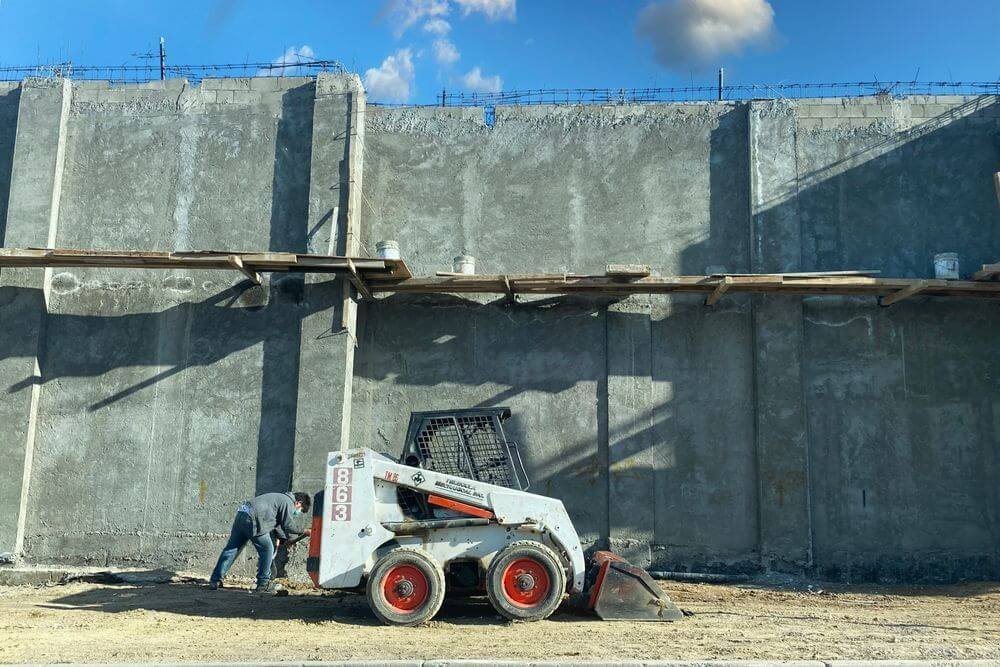

Modern construction projects often require materials and methods that balance strength, flexibility, efficiency, and cost. Conventional poured concrete remains suitable for many applications, but extensive formwork can make it difficult to use on irregular surfaces, restricted sites, or complex structural designs.
Shotcrete offers an alternative method of placing concrete that can reduce formwork requirements and adapt to challenging site conditions. It is commonly used for retaining structures, tunnels, slope stabilisation, swimming pools, excavation support, and architectural features across different regions and climates.
What Is Shotcrete and How Does It Work?
Shotcrete is a method of placing concrete or mortar by conveying it through a hose and spraying it onto a prepared surface at high velocity. This application process compacts the material as it is applied, helping it adhere firmly to the surface.
A shotcrete wall may be applied against soil, rock, reinforcement, a one-sided form, or an existing concrete surface, depending on the project. Because the material adheres during application, many projects require less formwork than conventional poured concrete.
There are two main application methods. With dry-mix shotcrete, dry cement and aggregate travel through the hose before water is added at the nozzle. With wet-mix shotcrete, the concrete is mixed with water before being pumped through the hose. Both methods can produce dense, high-strength concrete when the mix design, equipment, application, and curing are properly controlled.
The most appropriate method depends on factors such as project size, required output, access, material availability, reinforcement layout, and the experience of the application team.
Structural Performance for Demanding Projects
Shotcrete can provide strong structural performance when it is appropriately designed, reinforced, applied, and cured. It is frequently combined with steel reinforcement, fibres, anchors, soil nails, or mesh to create retaining and stabilisation systems capable of managing significant loads.
The spray application can produce a dense concrete layer that follows the surface beneath it. When supported by suitable drainage, reinforcement, joint detailing, and curing, this density can help improve resistance to water penetration, erosion, and certain forms of cracking.
Shotcrete can achieve compressive strengths comparable to conventional cast concrete. However, final performance depends on the specified mix, the quality of the materials, nozzle technique, surface preparation, compaction, curing, and site conditions. Skilled application and proper quality control are therefore essential.
Greater Flexibility for Complex Designs
Traditional poured concrete usually relies on formwork to define its final shape. Curved surfaces, irregular slopes, and restricted areas may require complicated or expensive custom forms.
Shotcrete reduces many of these constraints because it is applied directly to a prepared surface. It can accommodate curved walls, uneven ground, overhead areas, and complex shapes that may be difficult to construct using conventional formwork.
This flexibility is valuable in dense urban areas, mountainous locations, underground works, and sites with limited equipment access. It can also help designers integrate retaining structures with landscaping, terracing, pools, or architectural features.
Shotcrete does not remove every design limitation. Thickness, reinforcement placement, drainage, access, rebound, overspray, and finishing requirements must still be considered. Even so, it provides engineers and designers with more options when conventional forming methods are impractical.
Faster Installation With Less Formwork
Reducing formwork can simplify the construction sequence. Instead of building and later removing two-sided forms, crews may be able to apply shotcrete directly against a stable surface, one-sided form, or reinforced excavation face.
This can shorten installation time for suitable projects, particularly across large or irregular areas. It may also reduce the labour and materials associated with constructing, bracing, stripping, and disposing of conventional formwork.
Shotcrete still requires careful surface preparation, reinforcement installation, equipment setup, trimming, finishing, and curing. It should not be treated as an instant or preparation-free process. However, an experienced crew can apply substantial quantities efficiently once the site and equipment are ready.
For commercial projects, a shorter construction programme may support earlier completion. For residential work, reduced formwork and excavation may help limit disruption, noise, and the amount of time parts of the property remain inaccessible.
Cost Benefits Depend on the Project
Shotcrete can lower overall costs where conventional formwork would be difficult, labour-intensive, or expensive. Savings may come from reduced timber use, fewer formwork stages, faster application, and less excavation.
However, it is not automatically the cheapest option for every project. Specialised equipment, trained nozzle operators, concrete supply, access arrangements, reinforcement, finishing, testing, and waste management all affect the final cost.
A simple, straight wall with easy access may be more economical using another construction method. Shotcrete tends to offer stronger cost advantages when the site includes irregular geometry, limited access, steep ground, overhead work, or extensive formwork requirements.
Useful Across Different Sites and Regions
Construction conditions vary considerably around the world. Coastal projects may face salt exposure and moisture, while tropical regions may experience heavy rainfall. Colder climates require careful attention to freeze-thaw exposure, and dry regions may create additional curing challenges.
Shotcrete can be designed for many of these environments, but the mix and construction process must match the exposure conditions. Durability may require appropriate cementitious materials, reinforcement protection, drainage, curing procedures, coatings, or other project-specific measures.
It is also commonly considered for steep embankments, tunnels, mines, restricted-access sites, and unstable excavations. In ground-support applications, shotcrete usually forms part of a wider engineered system that may include soil nails, rock bolts, anchors, mesh, foundations, and drainage.
Potential Environmental Advantages
Shotcrete may reduce waste and site disturbance where it limits the need for formwork, excavation, or excess concrete. Applying the material directly to an existing contour can also help avoid unnecessary changes to the surrounding ground.
These benefits are not guaranteed. Rebound, overspray, trimming waste, cement content, transport, pumping equipment, and curing requirements all contribute to a project’s environmental impact.
Its sustainability performance should therefore be assessed across the entire project rather than based only on reduced formwork. When properly planned, shotcrete can support waste-reduction and site-efficiency goals without overstating its environmental benefits.
A Practical Option for Modern Construction
Shotcrete offers a useful combination of structural performance, adaptable application, reduced formwork, and installation efficiency. It is particularly valuable on projects involving irregular surfaces, limited access, retaining structures, ground support, or complex shapes.
Its success still depends on sound engineering, suitable materials, trained operators, proper drainage, thorough curing, and effective quality control. When these requirements are met, shotcrete can provide a durable and efficient alternative to conventional concrete placement.
For builders, engineers, developers, and property owners assessing modern construction methods, shotcrete is not automatically the best solution in every situation. However, where the design and site conditions suit spray-applied concrete, it can deliver meaningful advantages in buildability, flexibility, and project efficiency.