
For business owners and fleet managers, vehicles represent a significant capital investment. While most organizations diligently track mechanical maintenance schedules, tire wear, and fuel efficiency, one major source of depreciation is often left completely unchecked. That silent destroyer of vehicle equity is the sun. Prolonged exposure to intense ultraviolet radiation and extreme cabin heat can devastate a vehicle interior over just a few summer seasons. Understanding the hidden costs of UV damage is essential for anyone looking to preserve the lifecycle and financial value of their automotive assets.
The Financial Impact of Sun Degradation
When it comes time to offload fleet assets, the physical appearance of a vehicle cabin plays a surprisingly outsized role in the final appraisal. Visible cosmetic damage to a vehicle interior, such as a faded dashboard or cracked upholstery, can reduce an asset’s overall resale or trade-in value by 10 to 20 percent. According to major valuation authorities like Kelley Blue Book, substantial interior wear and sun damage automatically downgrade a vehicle’s official condition rating from Good to Fair.
Downgrading a business or fleet vehicle from Good to Fair condition typically results in a $3,000 to $4,500 financial penalty on a standard $30,000 to $40,000 vehicle valuation. Less than 5 percent of all used vehicles actually qualify for Excellent condition pricing at trade-in, largely due to the difficulty of preventing cumulative interior UV and heat damage over the lifespan of the asset. This drastic reduction in value is a critical factor to consider when you evaluate automotive fleet lifecycles or prepare to sell unused vehicles on the secondary market. Dealership appraisers systematically deduct the projected cost of interior reconditioning, parts, and labor directly from their final trade-in offers during initial walkaround inspections.
The Science of Heat and Material Breakdown
A parked vehicle acts like a greenhouse. A cabin can easily reach an internal temperature of 130 to 170 degrees Fahrenheit when the exterior ambient temperature is only between 80 and 100 degrees. Because they sit directly under the magnifying effect of the windshield, dark dashboards and steering wheels can reach peak surface temperatures of 160 degrees Fahrenheit or more in roughly an hour. The National Highway Traffic Safety Administration warns that vehicles can heat up very quickly, with temperatures rising 20 degrees in as little as 10 minutes when exposed to direct sunlight.
This extreme heat exponentially accelerates the release of volatile organic compounds from synthetic seat foams, plastics, and adhesives. This chemical breakdown process is known as off-gassing, and it is responsible for the hazy film that often coats the inside of windshields during the summer. The International Organization for Standardization established the ISO 12219-1 protocol specifically to measure and regulate the high concentration of toxic volatile organic compounds emitted inside vehicle cabins under severe solar stress. When continuous interior surface temperatures surpass the standard automotive manufacturing threshold of 185 degrees Fahrenheit (85 degrees Celsius), the protective UV stabilizers mixed into the plastics break down rapidly. Prolonged exposure causes photodegradation, a process that cleaves the chemical bonds in dashboard polymers, causing them to become brittle, lose tensile strength, and crack.
Protecting High-Value Interior Components
The costs associated with repairing sun-damaged components are staggering. The average cost of a professional dashboard replacement, factoring in both modern OEM parts and specialized labor, currently ranges between $2,500 and $2,900. Modern electronics are also highly vulnerable. Automotive LCD infotainment screens frequently suffer thermal failures when dashboard temperatures exceed 140 degrees Fahrenheit. This heat causes the specialized optical adhesive between the digitizer and the LCD to soften and bubble.
This heat-induced adhesive failure leads to a common malfunction known in the auto industry as ghost touching, where stressed screens register random inputs or become entirely unresponsive. Replacing a modern OEM infotainment unit that has suffered this fate frequently costs upwards of $2,500 per vehicle.
To protect your investment and avoid these massive replacement costs, proactive interior management is necessary. When it comes to daily protection, investing in the best sunshade for car windows is the most effective way to block harsh UV rays and drastically lower the surface temperature of your dashboard and steering wheel. Beyond regular shade usage, there are several practical strategies for mitigating UV and heat damage:
- Park in covered garages or shaded areas whenever possible, especially during peak solar hours between 10 AM and 4 PM.
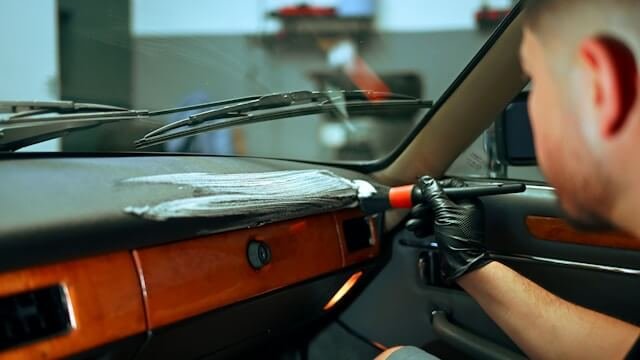
- Apply UV-protectant conditioning sprays to leather and vinyl surfaces monthly to replenish essential oils and prevent cracking.
- Consider installing ceramic window tinting, which rejects a high percentage of solar heat while maintaining visibility.
- Crack windows slightly if parked in a secure area to allow trapped superheated air to escape, reducing the greenhouse effect.
By treating sun protection as a serious economic priority, you can extend the functional lifespan of your vehicles and preserve thousands of dollars in resale value. Whether you manage a large corporate fleet or simply want to protect your personal commute vehicle, proactively blocking out the sun is one of the easiest ways to safeguard your bottom line.